
The pandemic accelerated telehealth adoption across healthcare, and ABA was no exception. Suddenly, many families received ABA sessions via video call rather than in-person. Some transition was forced and temporary; others discovered that virtual ABA actually met their family's needs better than traditional clinic-based or home visits. Today, virtual ABA is a permanent feature of the landscape, and families increasingly choose it by preference, not just necessity.
But virtual therapy raises legitimate questions. Can a therapist effectively teach behavior skills through a screen? Is the child really learning, or are they just watching videos? Does parent coaching work virtually, or do you need in-person modeling? The research has evolved, and the answers are more nuanced than you might expect. For some children and goals, virtual ABA is highly effective; for others, in-person is essential.
This guide explores what
virtual ABA actually is, what the research shows, and how to decide whether it's a good fit for your child and family.
Is Virtual ABA Right for Your Family?
Treetop offers both in-person and virtual ABA options. Contact us to discuss which format works best for your child's needs and your family's situation.
TL;DR: What You'll Learn in This Article
Virtual ABA therapy delivers behavioral instruction and parent coaching via video call, with therapists coaching parents to implement strategies in real time or reviewing recordings of sessions. Research shows virtual ABA is effective for many goals, particularly parent coaching, functional communication, and less complex behaviors. It's less effective for children requiring hands-on guidance, sensory input, or intensive motor skill development. Virtual works best for families who are motivated, have adequate space and technology, and live far from in-person providers. Efficacy depends more on therapist skill and family engagement than format. A hybrid approach, combining virtual coaching with periodic in-person assessment, often offers the best of both worlds.
Key Points
- Virtual ABA can be therapist-directed (therapist coaches child through screen) or parent-coached (therapist coaches parent who implements live).
- Research shows virtual ABA is effective for communication, behavior reduction, and functional skills, with outcomes comparable to in-person for many goals.
- Virtual ABA works best for school-age children with basic tech tolerance and for parent coaching models that leverage family strengths.
- Virtual ABA is less effective for very young children, children with significant motor deficits, and goals requiring hands-on physical guidance.
- Technology access, home environment, and family consistency matter more for virtual success than for in-person therapy.
- Hybrid models, combining virtual coaching with periodic in-person assessments, maximize benefits of both formats.

What Is Virtual ABA? Models and Formats
Therapist-Directed Virtual ABA
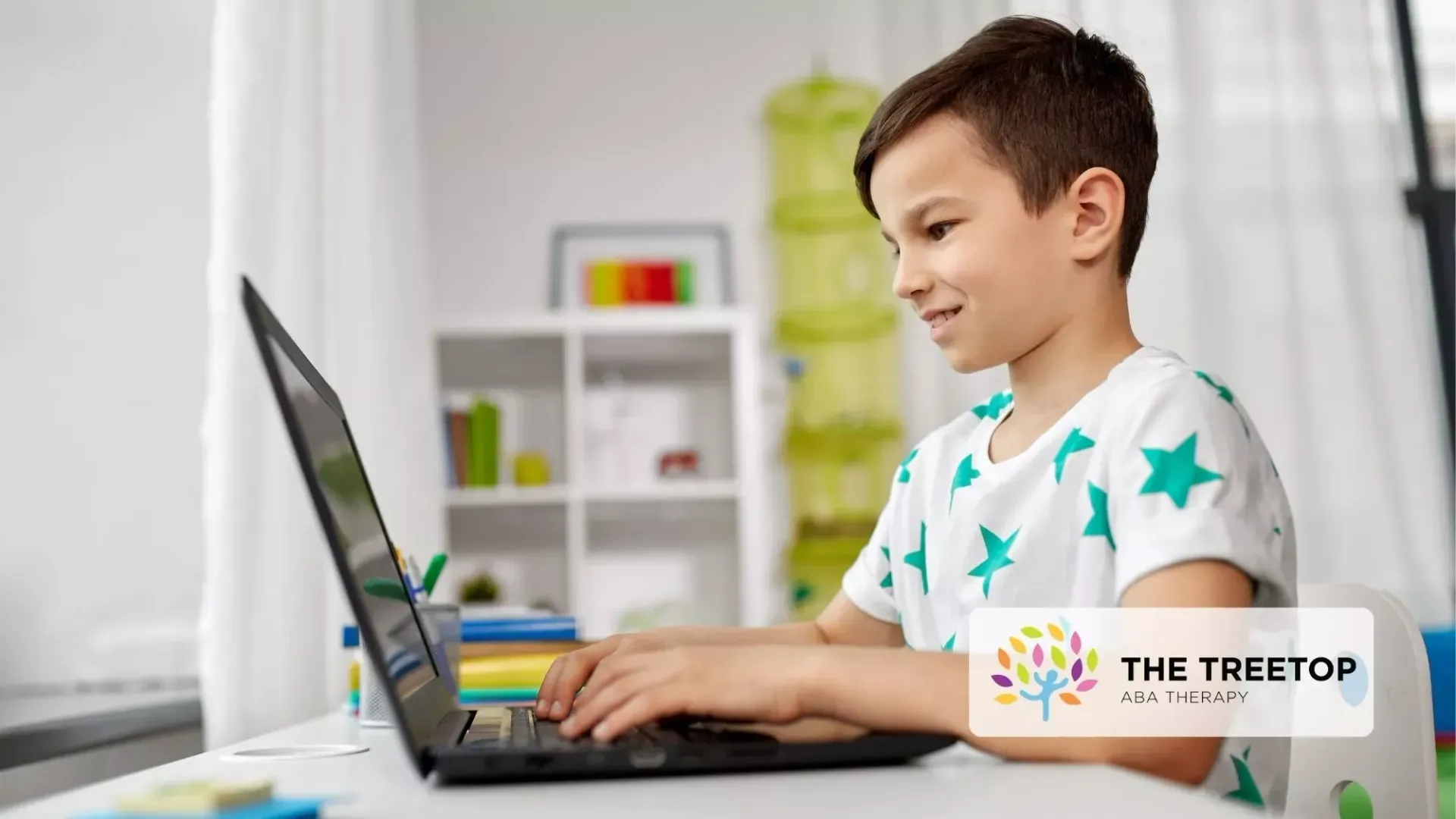
In this model, the therapist delivers instruction directly to the child via video call. The child is in front of a computer or tablet, and the therapist uses digital materials, games, and natural conversation to teach skills. The therapist can see the child's responses, redirect, and reinforce in real time. This works like a clinic session, except through a screen. It's best suited for school-age children with technology comfort and verbal or gestural communication.
Parent-Coached Virtual ABA
In this model, the therapist coaches the parent, who then implements strategies with the child. The therapist might watch a live session between parent and child, offer real-time coaching cues through an earpiece or chat, and guide the parent's behavior management. Alternatively, the parent records sessions, shares videos, and the therapist provides asynchronous feedback. This model leverages the parent's constant availability and the home environment as the teaching setting.
Hybrid Models
Many providers blend formats: regular virtual sessions for coaching, monthly in-person visits for detailed assessment and hands-on training, plus school coordination. This captures benefits of both: consistent virtual access plus periodic face-to-face refinement.
The Research on Virtual ABA Efficacy
What Does the Data Show?
Early studies from 2020-2021, conducted during lockdowns when in-person was impossible, found that virtual ABA produced outcomes equivalent to in-person therapy for many goals. A 2021 systematic review concluded that telehealth ABA shows promise for reducing disruptive behavior, improving social skills, and teaching communication. However, outcomes varied based on the child's age, the specific goal, the therapist's experience, and the family's engagement.
Where Virtual Shines
Virtual ABA shows strong evidence for:
- Parent coaching and behavior management training
- Functional communication and verbal behavior development
- Discrete skills like labeling, requesting, and turn-taking
- Behavior reduction when the parent is trained to implement strategies
- School consultation and coordination with teachers
Where In-Person Is Stronger
Research and clinical experience suggest in-person is preferable for:
- Very young children (under age 3) with short attention spans
- Children with significant motor deficits needing hands-on guidance
- Gross motor skill development (e.g., teaching running, jumping, climbing)
- Sensory integration and proprioceptive input
- Complex social situations requiring real-time interaction and non-verbal cues
Advantages of Virtual ABA
Accessibility and Geography
Virtual therapy reaches families in rural areas, small towns, or regions with few ABA providers. A family in Montana or rural Maine can receive services from a qualified provider in any state. This eliminates waitlists driven by geographic scarcity and opens access to specialized BCBAs in underserved areas.
Cost and Convenience
No travel time means more efficient service delivery. A family can fit therapy around school or work without commuting. For working parents or families with multiple children, virtual reduces friction. Some families pay slightly lower fees for virtual; others find it comparable to in-person.
Consistent, Comfortable Environment
The home is a powerful teaching environment. Skills generalize better to home and community when learned in context. Some children perform better at home than in an unfamiliar clinic, and anxious or sensory-sensitive children may be calmer on familiar turf.
Parent Engagement and Coaching
Virtual coaching naturally emphasizes parent training, since the therapist cannot directly manage the child hour-to-hour. This family-centered approach often leads to better generalization and sustainability. Parents learn to recognize and reinforce skills themselves, multiplying the impact of therapy hours.
Challenges and Limitations of Virtual ABA
Technology and Environment Barriers
Virtual requires reliable internet, a quiet space, and a child willing to sit in front of a screen. Not all families have these. Some children are screen-averse or have attention difficulties that make virtual learning harder. Others live in chaotic, unpredictable home environments where consistent virtual sessions are difficult to schedule.
Limited Sensory and Physical Interaction
A therapist through a screen cannot physically guide a child's hand, provide proprioceptive input, model fine motor tasks up close, or provide the tactile reassurance some children need. For children who require hands-on guidance or sensory input, virtual is inadequate alone.
Behavioral Management During Virtual Sessions
Managing a child who refuses to participate, leaves the room, or becomes disruptive is harder virtually. In-person, the therapist can pivot the activity, adjust the environment, or use proximity and structure. Online, options are limited. A child can turn off the device or run away; the therapist cannot follow.
Assessment Limitations
Detailed behavioral assessment and skill sampling are harder via video. A therapist cannot observe motor skills, sensory responses, or complex social interactions as fully as in-person. This limits the precision of treatment planning and progress monitoring.
Maximizing Virtual ABA Success
Is Your Child Ready for Virtual?
Consider virtual ABA if your child:
- Is school-age (6+) or older with some tech tolerance
- Can tolerate screen time and follow directions from an adult on video
- Has at least basic communication (verbal, signs, AAC device)
- Does not require intensive hands-on motor or sensory instruction
- Has a committed parent willing to participate in coaching
- Has a quiet, relatively distraction-free space for sessions
Virtual Model That Matches Your Family
Be clear about which virtual model you're choosing. Parent coaching works better for most families than pure therapist-directed virtual. A coaching model positions parents as the primary change agents, leverages natural routines, and creates sustainability after therapy ends. If you're considering therapist-directed virtual, ensure the therapist has specific training in telehealth and experience with your child's age and needs.
Technology and Environment Setup
Invest in reliable internet, a suitable device (tablet or laptop work better than phones), and a consistent, quiet space. Small touches: a favorite toy on hand, a visual schedule so the child knows what to expect: improve engagement and outcomes.
Want to Explore Virtual ABA for Your Family?
Treetop offers both virtual and in-person ABA, plus hybrid models. Contact us to discuss which format fits your child's needs and your family's life.
Frequently Asked Questions
Is virtual ABA as effective as in-person?
For many goals and children, yes. Research shows comparable outcomes for behavior reduction, communication, and parent-coached skills. However, virtual is less effective for very young children, motor skill development, and hands-on guidance. The answer depends on your child's specific needs and which model you're using.
My child refuses to look at screens. Can we still do virtual ABA?
If screen refusal is a primary goal, virtual therapy is probably not the best starting point. However, some children who initially refuse gradually acclimate, especially if the virtual session is high-reward and interactive. Discuss your child's screen sensitivity with potential providers.
Can my child learn to follow instructions or improve behavior through virtual ABA?
Yes. Instruction-following, behavior reduction, and basic skills can all be taught virtually, especially using a parent-coached model where the parent implements strategies in real time. The key is active engagement and consistent practice, not the format.
What if our internet is unreliable?
Virtual therapy requires consistent, relatively fast internet. If your connection is unreliable, discuss this upfront with your provider. Some providers use asynchronous coaching (where you record and send videos for feedback) if real-time sessions are not possible. Alternatively, in-person or hybrid models might better suit your situation.
Does my insurance cover virtual ABA?
Most insurance plans and Medicaid now cover virtual ABA following COVID expansions. However, coverage rules vary by plan and state. Check with your insurance before starting to confirm coverage.
Conclusion
Virtual ABA is not a downgrade or temporary fix. For many families and many goals, it's an effective, accessible, convenient choice. Research supports its efficacy for communication, behavior reduction, and parent coaching. The key is honest assessment of your child's needs, your family's strengths, and which virtual model: therapist-directed, parent-coached, or hybrid: aligns with your situation.
Virtual ABA removes geographic barriers, accommodates family schedules, and often emphasizes parent empowerment. A 2022 systematic review on telehealth confirms that when implemented thoughtfully, virtual delivery rivals in-person outcomes. Whether you choose virtual, in-person, or a blend of both, what matters is that your child is learning and your family feels supported.
Related articles